Thursday, November 1, 2018
What's scarier? A tiny of rump of ignored extremists, or an extremist majority government? Canada needs Proportional Representation!
Last week, I expressed alarm about the fact that 25,000 people voted for a known white nationalist in the Toronto mayoral election, representing 3.4% of the overall Toronto vote.
If a no-hope fringe candidate with a bit of money and media savvy could win that much support in Toronto, it was conceivable that similar percentages of voters in Canada could support white nationalist or other extremist parties in provincial or federal elections as well.
Under our current First-Past-the-Post voting system, 3.4% wouldn't likely translate into any seats. But under proportional representation (PR), they conceivably could.
Suddenly the idea of white supremacists gaining a foothold in Canadian legislatures became real to me and it scared me.
I've since recovered. Let me explain.
First, it's unlikely any proportional representation system we'd adopt in Canada would have a threshold as low as three per cent for representation. Currently, British Columbia residents are voting on some PR proposals that would set 5.0% as that minimum threshold for seats.
My post last week inspired a spirited debate with a progressive acquaintance who supports the Green Party who took issue with many of my points. He reminded me that, while extremists have been able to gain footholds in some European parliaments from time to time, they have not been able to win much if any influence. The bigger, mainstream parties have tended to shun the extremists. It's likely our mainstream parties in Canada would do the same and instead form coalitions with more moderate parties. The backlash against any mainstream party for jumping in bed with bigots would be too damaging to be worth it, as it is now.
One could easily expect that, even if extremists won a foothold with 5% of the vote in one election, they could easily slip below that threshold in subsequent elections.
Could such a tiny foothold one day grow much bigger as a result? It's possible. But under PR, they'd only ever win the representation their votes deserve.
But under First-Past-The-Post, the rise of an extremist party could be far more horrifying.
Today, an extremist party could jump into the teens or even 20 percentage point range under First-Past-The-Post and win a lot of seats, particularly if it were mostly located in one region.
Even more horrifying to conceive, if an extremist party got into the 30% vote range, they'd be capable of winning a majority government under First-Past-The-Post.
I've found most First-Past-The-Post apologists to be fairly smug and arrogant about how stable things are under it.
We just saw a conservative party in Quebec, with an anti-immigrant agenda, win a big majority with only 37% of the vote, after all. There, the Liberals, Parti Quebecois and Quebec Solidaire, all more friendly to immigrants, took a combined 58% support from Quebecers. Yet that translated into only 40% of the seats.
While I am disgusted by the idea of extremists winning toeholds in our legislatures under PR, I am more disgusted by the constant reality of parties with only minority support winning majority governments under First-Past-The-Post.
What's more scary? Small parties winning rumps in the corner of our legislatures, exposing their members to scrutiny and possible scandal, all the while the mainstream parties shun them? Or a far-right mainstream party, like the one headed today by Doug Ford, taking full control of our province now with only 40% of the vote?
Today, we have an idiot drunk on conservative ideology in charge of Ontario, claiming he's got a mandate to stop carbon taxes despite winning only 40% of the vote.
Today, 54% of Ontarians say they're in favour of Justin Trudeau's carbon tax plan. Yet, Dougie remains convinced he's got Ontario's support as he tries to undermine the best way to combat climate change and transform our economy for the modern era.
First-Past-The-Post distorts the wishes of all voters every time.
PR reflects those wishes, warts and all.
I'm prepared to live with the occasional wart as long as the giant mess that is First-Past-the-Post goes away.
If one party wins 40% of the vote, it should not win 60% of the seats. It shouldn't win 55% of the seats. It should win 40% of the seats.
Any system that would hand Donald Trump the presidency with three million fewer votes than Hillary Clinton is broken. And First-Past-The-Post / Winner-Take-All frequently hands power to the vote loser.
We are a democracy. It's time our voting system actually reflect that.
As I mentioned, B.C. is holding its own mail-in referendum this month. First-Past-The-Post is once again up against Proportional Representation. Voters are also being asked to select which PR system they'd like to move to should PR be supported by over 50%.
On that front, I hope that Dual Member Proportional wins.
Tuesday, October 23, 2018
The strongest argument against proportional representation I've ever seen: Faith Goldy's 3.4% vote for Toronto mayor
 |
| Toronto mayor final voting results |
Yesterday, Torontonians voted in their municipal election and re-elected John Tory by a wide margin with 63.5% of the vote. Second place finisher Jennifer Keesmaat finished way back but with the still substantial 23.6%.
But Faith Goldy, a far-right propagandist who works through a white supremacist lens and has talked about an upcoming racial civil war in North America, took a disturbing 25,667 votes across the city, or 3.4% of the vote.
 |
| Faith Goldy and supporters with Ford at Ford Fest last month |
For that, she was fired from Rebel. It's sad to realize that despite that at least one of her videos still appears on the Rebel's YouTube channel.
Goldy recently made an appearance at Doug Ford's 2018 Ford Fest and got photographed with the premier. When questioned about this, Doug Ford first found it difficult to disassociate himself from her.
Goldy's mayoral candidacy got little mainstream media attention. In the few mayoral debates that took place, she wasn't invited (although she did try to force herself into at least one of them.) In fact, John Tory explicitly said he would not stand on the same debate platform with a white supremacist.
But Goldy's signs were all over the city and she had enough money to launch robo-calls and other outreach to voters. And in the end, she garnered 3.4% or 25,667 votes.
This is the kind of thing that opponents of proportional representation have been warning us about and I must say today I am deeply alarmed.
Yes it was a mayoral race, but if this dubiously qualified candidate can win this much support in a mayoral race in Toronto, imagine what she or similar racists in a political party could win in a general election.
I've argued before that proportional representation is a better voting system than our current First-Past-The-Post system.
But today, I'm not so sure. As we know, in the Ontario model of proportional representation that was defeated in 2007, three per cent of the vote province-wide was the threshold for winning seats in the House. That party would then be able to use that representation to influence the larger parties. Winning that toehold in one election would likely mean its support could grow as potential voters realize they're not wasting their votes on them.
Yet, our current system tends to shut out extremists like this. It's not enough to win 3 or 5 per cent of the vote, one has to win a wider amount of support enough to carry the most votes in at least one seat to earn representation.
This reality has shut out extremists like Faith Goldy from gaining representation and more power in our legislatures with which they could do great harm.
Of course, First-Past-The-Post also has its many flaws. It hands parties with a mere plurality of support majority power. Sometimes it even hands the losing party the most seats, as it did recently in New Brunswick.
A friend of mine on social media recently commented in support of First-Past-The-Post, stating "there is no question that FPTP ensures that political parties are only successful if they avoid extremes and extremists."
In some ways, that's true. Parties will usually aim toward the mainstream in order to win enough broad support to win seats and government. Parties that only aim toward the tiny minority that are white supremacists and ignore the rest of us cannot usually win seats under FPTP.
In the United Kingdom, the xenophobic UK Independence Party won an incredible 12.6% support in the 2015 election, but that only translated into one single seat out of 650. In the next election, its support fell way back to 1.8% and zero seats.
Yet extreme parties like that would win seats under proportional representation. I'd personally favour a five percent cutoff for representation under PR, but even that total could be exceeded by some upstart white supremacist party, as Goldy's 3.4% total yesterday makes clear.
I equate white supremacists with homophobic bigots on the religious right. And there's no doubt that the shrinking proportion of religious fundamentalists who would destroy the lives of all LGBTQ people have been frustrated of late as their influence also recedes in Canada.
They've responded to this reality by continuing to stay active in the Conservative parties across the country. But even in those parties, their influence is diminishing. The Conservatives no longer explicitly oppose same sex marriage, for example.
Yet, far right activists still have had some success in Conservative parties. Loser candidates with almost zero qualifications for leadership - like 19-year-old home schooled Ontario MPP Sam Oosterhoff, or Saskatchewan MP Brad Trost - seem to regularly win big amounts of support in that party.
Earlier this year, right wing extremist Tanya Granic Allen ran a one-note campaign in the Ontario PC leadership race against Ontario's inclusive school curriculum (brought in by Kathleen Wynne, it actually acknowledged the existence of LGBTQ kids in our schools.) Granic Allen garnered an incredible 15% of the vote, almost as much as Caroline Mulroney. In the end, that 15% of the vote was crucial to "electing" Doug Ford as PC leader, who's now gone on to become premier and cancel that inclusive curriculum (while still ditching the horrid Granic Allen from his candidate roster after some more homophobic comments of hers were revealed.)
So while no far right fringe party has representation in the Ontario legislature, its influence in determining the outcome of the Conservative leadership shows that the big tent parties under First-Past-The-Post are still vulnerable.
Yet I have to say that I prefer the status quo over seeing a contingent of bigots winning representation under some possible proportional representation system. While the influence of the far right on the Conservatives remains real but not overwhelming (and they have virtually no influence in the Liberal Party, the NDP or the Greens,) there's no doubt that influence would grow substantially were they to win a foothold of actual seats in our legislatures.
The far right extreme is not going away. It's true that certain conservatives like Doug Ford or Donald Trump have been able to appeal to them in order to win power under Winner Take All or First Past the Post. But those same conservatives under these voting systems must still appeal to the much bigger mainstream, and thus that influence is diminished, it seems. I'd hate to see what a Conservative Party coalition with Faith Goldy's far right fringe party might accomplish under proportional representation.
Suddenly, I find myself questioning my whole support for PR. Most PR proponents tend to be well-meaning left-wing activists or environmentalists. But as they say, the road to hell is paved with good intentions. Perhaps progressive folks like me who want to stop the flaws of First-Past-The-Post should look to other systems to fix it.
Perhaps ranked balloting - the kind that Justin Trudeau wanted to implement federally and which now exists municipally in London, Ontario - is the better alternative than a system that might give an amplified voice to the far right extremes of our society.
*************
UPDATE: After some good debate and thought, I've re-thought this and still support Proportional Representation over our current broken First-Past-The-Post system. Click here for my update.
Sunday, September 30, 2018
New Brunswick and now Quebec elections once again expose major flaws with our voting systems...
 |
| CAQ's François Legault could win majority with only 30% of votes |
It's worth noting that in every emerging democracy in recent decades, proportional voting systems have been put in place in order to keep extremist minority impulses in check.
Yet here in Canada (as well as Britain and the United States), our archaic Winner-Take-All / First-Past-The-Post voting systems persist. In Canada and the U.K., parties win seats by simply taking the most votes in the seat. So one entire seat can be occupied by one party for an entire parliament simply because it won as little of 25% support in it, as long as all other candidates splintered the remaining 75%. One party has regularly been able to win a majority of seats despite winning well under 40% of the overall vote in a province or country.
Similarly in the U.S., as we know, the electoral college elected Donald Trump because he won achingly close victories in just the right number of key states, even though Hillary Clinton had overall won 2% or almost three million more votes across the entire country.
As Andrew Coyne (long an advocate for proportional representation too) states here, Winner-Take-All / First-Past-The-Post tends to produce results wildly disproportionate from the actual voting when three or four major parties are competing.
Clearly, electoral systems that distort voters' wishes should be replaced. Yet those who control any processes for change of course have conflicts of interest as they won power because of the current system.
It was little surprise that Justin Trudeau turned his back on his electoral reform promise when it was clear the only change he wanted would be unacceptable to all other parties and most reform advocates.
Other referendums have been held in Canada, including in Ontario in 2007 when the McGuinty government also lost its zeal for change after winning a big majority under the current system in 2003. In that 2007 referendum, the Grits determined that 60% support was needed for change (a similar and unfair high mark has been the norm in most Canadian referendums on this topic.) The McGuinty Liberals also refused to fund education campaigns that might explain to voters the real weaknesses and strengths of both systems. Into that void jumped the private sector media including the Toronto Star which was more than happy to misinform the public with scary stories about Italian pizza parliaments and chaos. Thus, cautious Ontario voters had little information and overwhelmingly backed the status quo. It's been that sense that Canada, as well as the U.S. and U.K. seem to be strong societies and economies (at least for the privileged and white majorities), so why do we need to fix something that may not be broken?
Of course, I'd argue that any system that elects Donald Trump as president despite him winning 3 million fewer votes is broken, and the dire consequences are now obvious. If our societies are strong, it's despite of our voting systems, not because of them.
In New Brunswick last Monday, the governing Liberals took 38% of the vote, versus 32% for the Conservatives, as well as about 10% each for a new party called the People's Alliance (PA) and the Green Party.
But this translated under First-Past-The-Post into 22 seats for the Conservatives, 21 for the Liberals, 3 for the PA and 3 seats for the Greens. The governing Liberals under Brian Gallant pledged to try to win the confidence of the House at their first opportunity, as would be customary after a result like this. Yet that didn't stop New Brunswick Conservative Leader Blaine Higgs from claiming a "mandate to govern" which actually doesn't exist. The fact that his party shrunk in voter support from the previous election and now lagged behind the Liberals by 6 points meant nothing to him.
Tomorrow is voting day in Quebec's provincial election as well, and there too it seems that First-Past-the-Post will distort voters' intentions. Polls show the moderately conservative party Coalition Avenir Quebec (or CAQ) slightly ahead of the governing Liberals, with both hovering around 30%. The separatist Parti Quebecois seems to be on the ropes now well back at 20%, and the upstart far-left Quebec Solidaire just behind them.
Because of this four-party splintering, it makes it hard to predict. However, the CAQ has a clear lead among francophone voters who make up the vast majority in 100 of the province's 125 ridings, while the Liberals have weak francophone support (but still have overwhelming support from anglophones and allophones who live mostly in Montreal.) So analysts predict this will lead to a bounty of seats for the CAQ, perhaps even enough to win a majority of seats in the province. Thus we could end up seeing a majority government with only 30% voter support. That's repulsive.
Is there hope for change? One better hope for a CAQ minority government with the Quebec Solidaire and the PQ holding the balance of power, I say, as all three of those parties have pledged they will move toward a proportional voting system after this election. A minority government would keep the CAQ government's feet to the fire, perhaps forcing change. A majority CAQ government would likely abandon changing a system that gave it all the power, I predict.
Even in Alberta, where the NDP finds itself in power for the first time ever, you'd think that Premier Rachel Notley would seize this opportunity and bring in proportional voting. I'm shocked that she hasn't, frankly, as her party has long been shut out of any decision-making prior to 2015 because of the current system. It now looks likely that the united Conservatives there will romp back into power in 2019 and leave the NDP back in the wilderness for decades. That's a shame. (Remember that every time a sanctimonious New Democrat chastises the Trudeau Liberals for not implementing electoral reform - ask them why Notley's NDP in Alberta didn't bother when they had the chance.)
There is one major glimmer of hope on this issue in British Columbia, where the minority NDP government was able to take power with the support of three Green Party MLAs, ousting the conservative Liberals last year. The Greens made the NDP agree to hold another referendum on changing the voting system, which will happen this fall. This time, the rules are fair with 50% needed for victory. Polls there show PR slightly ahead of First-Past-The-Post, with almost as many undecided.
If British Columbians can finally embrace a fair voting system, it will give the push for change a huge amount of momentum across the country. If Quebec also moves to proportional voting, it will help even more. Suddenly the cynic in me could be replaced by an optimist on this issue again.
But I'm not naive about any of this. For various reasons, this issue does not seem to inspire much interest in most voters (which is another reason change has been so difficult to achieve.) When I write about it on this blog, I find that I get the least number of reads. I predict this post will be no exception (so if you read this far, I personally owe you a drink - private message me to arrange ;-))
Saturday, September 29, 2018
Here's to the women who can teach all men about dignity in a dangerous world...
 Like many people, I've been watching this week's events in the U.S. closely as Brett Kavanaugh fights for a lifetime seat on the highest court amid very credible allegations he raped women earlier in his life.
The white patriarchy as represented by the Republican Party has been hard at work defending him, pointing as ever to the notion that everyone should be considered innocent until proven guilty in a court of law. Of course, they only truly mean that for white heterosexual men like them, preferably from good stock and wealth.
I've always deeply admired the women in my life, and most women everywhere, who've persisted and frequently succeeded despite systemic sexism. I've often wondered how many could maintain such dignity and calm amid these conditions, as I am someone whose passionate views sometimes push me into anger even though I've only suffered discrimination based on my sexual orientation (but have benefited from white and male privilege.) So those examples of dignity and calm have meant so much to me as I've tried to emulate them and keep my own anger in check. For as we know, a loud angry voice can easily be dismissed by the powers-that-be.
As Mahershala Ali says in the first trailer for the new film Green Book (which I can't wait to see): “You never win with violence, you only win when you maintain your dignity.”
 |
| By Bruce MacKinnon, Chronicle Herald in Halifax. |
I find it hard to believe Ford is not being completely honest. I also find it hard to believe the likes of Kavanaugh. Despite what may end up being a token week-long FBI investigation, it's likely the powerful white men who dominate the U.S. Senate will push his nomination through despite these revelations, because the Republican Party, like all conservative parties, is really about maintaining and strengthening the patriarchy against everything else.
But hopefully more women will continue to fight and turn their backs on the men who don't seem to care about them much. That means never voting for political parties or candidates who don't support them including their right to live free from male violence.
The #MeToo movement is happening at a crucial time. This is yet another step in the way of progress. It will be a constant battle and it's unclear how we will resolve these issues.
The current system of justice is not working for women on this issue. The burdens of proof needed to convict the guilty are often too high as most cases tend to be one woman's word against one man's word. In those instances, the lying man goes free. Because of this, few survivors come forward.
Perhaps the answer is a society where surveillance of all human behaviour is the norm, so proof of wrongdoing is instantly caught on camera. China is already heading in that direction. Western cultures have been much friendlier to men who would do great wrong, knowing they'd never be caught. Who knows? If China does become the dominant world power this century (which seems likely thanks to America's continued collapse under the Republicans), maybe that's where we're headed. Sure you can be considered innocent until the surveillance video from that party proves you guilty.
 Of course, I'm not being entirely serious with that last paragraph, but perhaps it's a good point to think about. Women, people of colour and many others already maintain such dignity and calm amid hostile conditions - a move to that kind of state wouldn't be much different than what they're experiencing right now.
 Of course, most of the white cisgendered heterosexual males who've never had to live under such circumstances would think differently. They like things the way they are just fine. The meme of Brett Kavanaugh on the right sums up these sentiments perfectly.
Fighting against and dismantling these systems of oppression takes decades, if not centuries. Immoral people with power will never give it up easily. Those who have been on the outside fighting know this too well. I stand next to them and pledge to continue the fight for justice.
Friday, June 15, 2018
Great news from the Supreme Court against discriminatory law school in BC
 |
| Sign on display at Amyx Hardware in Tennessee since 2015. |
When the U.S. Supreme Court, loaded with conservative appointees who don't respect the basic human dignity of LGBT people, recently ruled that private businesses can discriminate against gay people for religious reasons, I was enraged.
State-sanctioned or court-approved bigotry has no place in a fair and just society.
Today, with this Supreme Court ruling against Trinity Western "University" in BC, I feel ecstatic and lucky to be living in Canada, a country where we respect basic human dignity.
The balance of rights is a careful one that our Supreme Court has always gotten right, in my opinion. Does the school's desire to keep out all forms of homosexuality trump the basic dignity and rights of prospective LGBT law students? Is the harm done to the latter through such a discriminatory policy unimportant when compared to the desires of Christian bigots to learn about law and ethics in a gay-free environment (or free from anything else they might deem "sinful")?
The answer is a clear no. In fact, allowing such discrimination in a public institution would go against everything this country stands for.
This Straight.com article sums up the issues nicely.
The religious still have the right to discriminate and attack the basic dignity of people they needlessly hate in their own private religious institutions and homes. But keep it there, thanks very much.
Tuesday, April 17, 2018
Tri-Curious gets the DVD treatment starting April 21st!
 |
| The DVD cover for CAS |
In 2016, I was very proud to write, produce, direct and edit my own short narrative film called Tri-Curious. It's a sexy comedy about how last minute anxiety threatens to ruin a young gay couple's first threesome together (see the trailer link on the right.)
A great group of friends and colleagues helped me make it, along with actors Trevor Ketcheson, Rob Salerno and Mike Went. I worked so hard on it and I continue to be immensely proud of our efforts.
The short went on to get programmed in 2016 and 2017 at various film festivals around the world (but sadly not in Toronto) and even got picked up by LGBT-themed video-on-demand site Dekkoo.
 On top of that, I put the film on YouTube where it garnered an incredible 1.5 million views in 10 months! It's no longer available on YouTube as I've now sold the exclusive distribution rights for five years to Dekkoo (which is associated with LGBT film distributor TLA Releasing).
The result is their upcoming DVD release, CAS, a collection of three films that examine the different effects the addition of a third party has on a modern gay relationship.
The DVD gets released on April 21, 2018 and is available now for pre-order at this link.
Tri-Curious will be tucked in between the 50-minute Dutch TV short Cas, by director Joris van den Berg, and the U.S. short Bed Buddies, by director Reid Waterer. I'm thrilled!!
If you'd like to check out my film and also get two other great shorts thrown in, please consider buying the DVD for your collection. You can also see my short right now if you wish by clicking on this Dekkoo VOD link and starting a trial membership.
Saturday, March 31, 2018
'Love, Simon' success a sweet sign of the times
 |
| Characters in 'Love, Simon' |
The film, starring the lovely Nick Robinson and joined by a fab cast, is based on the novel Simon vs. the Homo Sapiens Agenda by Becky Albertalli, and tells the tale about a closeted teenager who develops a secret email/pen pal relationship with another closeted teen in his high school.
Director Greg Berlanti handles it all delicately and beautifully, giving this story a common touch that is allowing it to find mainstream audiences. While there is some typical rom-com formulaic writing (and you just know that this has to be headed for a happy ending), the story and diverse characters were still original and well-acted enough to keep it fresh and compelling. As of March 30, its estimated $30 million at the North American box office already far outstrips the entire run by the recent Oscar-nominated Call Me By Your Name.
Why? The producers clearly wanted this gay story to appeal to the masses and it appears to be doing so. I went to an opening night screening on March 16 in Toronto and it was pretty packed, with a majority young females. At a key moment of sweet, romantic, boy-on-boy kissing action, those girls squealed with delight and made the movie going experience sublime. That stands in stark contrast with the howls of hatred and homophobia that would accompany the appearance of any gay characters onscreen in decades past in North America.
Now it seems North American teenage girls (at least those not brainwashed by religion) have finally caught up to their counterparts in Japan, where the idolization/eroticization of male homosexuality went mainstream long ago. Yes, here it's pretty PG-rated so far, but that's cool by me. (As we know, North American teenage boys and elsewhere long ago eroticized lesbians.)
There will be those who quibble with the fact this is another in a short list of mainstream feature films where the lead gay character is masculine, cisgendered and white. The plot finds a way to effectively counter some of those quibbles (I won't give anything away here), including the fact that the lead is always surrounded by characters who are quite diverse in terms of backgrounds.
Of course, this is just one film and LGBTQ characters still have a ways to go on screen. The recent Black Panther is one example where a mainstream film erred on the side of too-much caution by refusing to make the lesbian relationship in the original works explicit in the feature film adaptation. Fans looking for queer representation in the recent Star Wars reboots continue to be disappointed too.
It's one thing to gamble $17 million on Love, Simon (a gamble that has already paid off big time.) It's another to gamble $400 million on a picture that depends on worldwide box office success to make a profit. And as we know, homophobia and bigotry still reigns in most parts of this world. This issue has been with us for decades and continues to be relevant.
Still, I cherish the fact that we're living in a time when a sweet love story like Love, Simon can become a decent box office success carried by the ticket purchases of young heterosexual ladies (and many LGBT folks as well.)
Saturday, December 30, 2017
My Favourite Films of 2017 - UPDATED

1. The Florida Project:
2. Dunkirk: Stunning visuals and direction from Christopher Nolan, as well as a stunningly hot and talented cast, depict the efforts to rescue the British and French armies from the beach in France in early World War II. Gripping and beautiful to watch, I loved this war film from beginning to end. It's nice to see Nolan stay true to his vision, perfectly execute it and now receive the acclaim and hopefully the nominations he deserves.
3. Lady Bird: I saw this recently and loved it. Saoirse Ronan gives a performance as equally lived in and authentic as Timothée Chalamet did in Call Me By Your Name. This is a brilliant character study and I loved the unique relationship portrayed between daughter and her mother, played by the amazing Laurie Metcalf, who I haven't seen much of since Roseanne. I also adored Tracy Letts as Lady Bird's dad, as well as Lady Bird's relationship with her best friend Julie, played by Beanie Feldstein. There are so many moments in this gem that I truly cherished. Touching, intimate filmmaking here by Greta Gerwig. (Formerly #9 but moved up after some more consideration.)
4. Call Me By Your Name: This film is a sensuous delight that perfectly captures a unique moment in time and place for its characters. It's the classic coming-of-age/first love tale many of us in the queer community have always hoped to see, free from queer film tropes like gay bashing, hateful parents or inevitable punishment and death. This film chronicles the evolution of young Elio from genius yet inexperienced teenager to broken-hearted adult, and actor Timothée Chalamet embodies the role with seemingly effortless authenticity and feeling. He is the beating heart and soul of this movie. (This was my #1, but upon more reflection and another viewing, I do find the romance fairly unsatisfying here; it works mostly as a one-sided reflection or memory of a teenager's first love that got away rather than a true romance. Plus Armie Hammer's performance seems often unconvincing to me.)
5. Get Out: This timely, anti-racist, satirical masterpiece by director Jordan Peele was released last winter, yet is now poised to do well this awards season, even perhaps take Best Picture. It deserves to. It's a perfect, original exploration of its subject matter about a young black man who visits the home of his white girlfriend only to find a house of horrors, playfully pushing buttons that need to be pushed today in our culture. Loved it!
6. The Post: Steven Spielberg taps into the zeitgeist today in this note perfect film about the 1971 backroom deliberations at the Washington Post to possibly publish details of the infamous Pentagon Papers after the New York Times had been temporarily barred from doing so. There is heady stuff here including the fight between government and the press, the competition between newspapers, the fight for equality and respect for women in the workforce. And it's all handled with a non-melodramatic touch that felt completely realistic and appropriate. Spielberg does thankfully keep some of his stylistic Spielbergisms in check, focusing on moving the story forward at all times. And the film is gorgeous including the 1970s art direction and the awesome focus on the old-fashioned news gathering and editing process, not to mention the printing press mechanics. Meryl Streep is perfect as are the rest of the cast. I was born to love this movie!
7. Baby Driver: Super-hot Ansel Elgort plays the sympathetic driver nicknamed "Baby" who transports his fellow crooks away from their crime scenes. Every element of this film - from the music, to the editing, to the sound, to the writing, to the acting - is masterful. I watched this before the Kevin Spacey scandal erupted, so I have no idea if his presence might ruin it now for viewers. But I suggest it's still demands a try.
8. The Shape of Water: This just might be director Guillermo del Toro's best, most accessible film. It's certainly my favourite one of his. It's still a little strange, but what else could it be coming from him? Let its beautiful colours, sounds, effects and performances wash over you as soon as possible, I say.
9. Okja: If you've never thought about the conditions in which your food is engineered and brought to your table, you need to see this film immediately. Director Joon-ho Bong does some of his best work here ever, artfully telling his tale without being preachy. If you have Netflix, watch it! Not only does this film enormously entertain, it inspires audiences to think. It certainly inspired me to start buying "free run" eggs despite the extra costs, although I'm not quite ready to give up meat.
10. Detroit: I didn't know much about the 1967 Detroit riots, nor the shocking and heart-breaking Algiers Motel incident that took place during it, before watching this film. But I do now thanks to the incredible talent of director Kathryn Bigelow. Harrowing and essential viewing for anyone who thinks the police are just great and that black people complain too much about discrimination and police violence.
11. I, Tonya: Hilarious and completely entertaining. Margot Robbie superbly captures the essence of Tonya Harding's humanity, in all its tragedy and ridiculousness. Allison Janney as her mother is an unforgettable villain. The rest of the cast is awesome, as are all other elements in Craig Gillespie's film.
12. Film Stars Don't Die in Liverpool: I read that many people were moved to tears during Call Me By Your Name or Lady Bird, but I wasn't. But I did cry toward the end of this lovely film, which tells the tale of aging Hollywood starlet Gloria Grahame's affair with a much younger man, upon whom she depended during the final months of her life. Annette Bening is perfect as Gloria Grahame, as is the supremely sexy Jamie Bell as Peter Turner, her lover.
13. The Big Sick: I didn't think that star Kumail Nanjiani was sexy before seeing this movie, but I definitely do now. Funny that. Fabulous all around.
14. Wonder Woman: Director Patty Jenkins (who helmed Monster back in 2003 with Charlize Theron) outdoes herself with this perfect telling of the famous heroine's story. I'd always lamented the fact that Hollywood had not yet put Wonder Woman on the screen, but considering how great this film is, the wait was worth it.
Honorable mentions:
Battle of the Sexes
God's Own Country
Spider-Man: Homecoming
Land of Mine
Mudbound
I Am Not Your Negro
An Inconvenient Sequel: Truth to Power
Star Wars: The Last Jedi
All the Money in the World
The Lost City of Z
Victoria and Abdul
A Bad Moms Christmas
Blade Runner 2049
Stronger
Strangest, completely fucked, but a masterpiece:
mother!: Darren Aronofsky's most daring work can only be viewed and understood as an extended, tragic and violent metaphor. It's a tough watch and definitely not for everyone. But I've never seen anything else like this movie and remain glad I got through it.
Disappointing:
Darkest Hour: Gary Oldman gives a great performance as Winston Churchill. But director Joe Wright has no idea how to make historical dramas gripping. Instead, he spends his time using odd lighting and showing his hero "huffing and puffing" and marching quickly down dark hallways. In calling it Darkest Hour, they mean that literally. This is the most poorly lit film I saw this year.
Three Billboards outside Ebbing, Missouri: I thought Frances McDormand, unlike in previous roles, was a little one note here. There were many great characters here with stories playing out especially with Sam Rockwell, whose character was thoroughly repulsive. Overall as a film: not horrible, but I just didn't like it that much including the (spoiler alert) non-ending.
Beach Rats: Where was all the much-hyped male nudity? And haven't I seen this closeted teen story done this way dozens of times before?
It: Unsettling and not in a good way. Watching kids fend off child molesters and killer clowns for two hours is not my idea of entertainment.
The Dark Tower: Way too short and rushed.
Valerian and the City of a Thousand Planets: Lots of visual eye candy but little depth.
Kingsman: The Golden Circle: Ugh, nowhere near as enjoyable as Part One.
The Great Wall: Look, it's white guys saving the day in People of Colour land again.
Life: Look, the black guy is the first one to die again. Couldn't finish it. How do you make a film with Jake Gyllenhaal and Ryan Reynolds together in tight quarters, and yet it still disappoints?
Worst film of 2017:
Geostorm: Makes all other apocalypse films look like masterpieces. So bad.
Wednesday, November 29, 2017
Tuesday, November 28, 2017
When good people like Nancy Leblanc step away from partisan politics, we all lose...
As long as we've recorded human history, we've known that politics is a nasty business, perhaps the nastiest. But also one of the most important - the pursuit of power will always be.
Plato wrote about a "philosopher king" as the ideal ruler. Such a person in practise has never existed, of course. Or if such a person actually did pursue political power, their idealism and principles would soon undermine those efforts. No doubt, history is filled with thousands of such decent people who considered politics but stepped back rather than compromise their integrity and ethics. The tragedy here is the absence of decent people relinquishes the realm of politics to the ruthless, nasty, amoral jerks who make up the vast majority of our politicians and those who work for them.
So there is nothing profoundly new about this post, except highlighting just the latest example of how the nastiness of politics has once again pushed aside a decent person. Nancy Leblanc is such a person. She may humbly disagree with being compared with a "philosopher queen," but for me, the comparison is apt as Nancy is exactly the kind of person our politics needs: someone who's in it for the right reasons, to help make people's lives better and to promote better public policy and governance.
Nancy is an accomplished Toronto lawyer who entered the political arena in 2014 as the Ontario Liberal candidate in Parkdale-High Park in west-end Toronto, then considered a thankless task taking on NDP veteran incumbent Cheri DiNovo.
Given only a handful of weeks to raise tens of thousands of dollars and her public profile, Nancy ran a great campaign and came within 600 votes of knocking off the well-entrenched incumbent. Had the party deemed to allow her to take the nomination sooner, as it did other non-incumbents in Toronto NDP ridings, Leblanc might've prevailed.
"I got involved in the political process because I sincerely want to make a difference in people's lives for the better. I am a lawyer and as such ethics and integrity are very important to me. So after coming so close to winning in 2014, I persevered and continued to work in good faith because I knew I could do a good job of representing this riding," said Leblanc in a statement this week.
Since 2014, she's continued working in the grassroots, knocking on well over 20,000 doors in her riding, engaging with and advocating for local residents, working on riding specific policy ideas for the coming 2018 election.
She also used her considerable organizational skills to raise $50,000 for the local riding association, as well as raise over $50,000 for the Ontario Liberal Party separate and apart from riding resources.
She is the ultimate grassroots candidate with the kind of skills, local base and established profile you'd think the Ontario Liberal Party would want to take on the NDP again in 2018.
But sadly that doesn't seem to be the case and that's a shame. Another nominee with no public profile who doesn't even live in the riding, but close with the party backroom, seems poised to take the nomination instead.
Leblanc announced yesterday that she won't be continuing to pursue the Liberal nomination.
"I have come to believe that the path for me to continue to make a difference for the people here in Parkdale-High Park is not with the Ontario Liberal Party in 2018. This was a very difficult personal decision to make, especially after all the hard work over the past few years, but it is one that I have firmly made after much consideration around all of the circumstances involved," said Leblanc.
In life and in most professions, massive hard work, intelligence, integrity and years of grassroots campaigning will usually produce results.
But not in politics, sadly. Certainly not in Ontario provincial politics, it seems, these days. This is a major loss to the Ontario Liberal Party and to all Ontarians, frankly.
Despite this setback, Leblanc would still make an incredible politician and community leader and I hope she finds other ways to serve the public in the future. If she does take the plunge again, I will support her 100 percent.
Because if good, decent people like her step away from politics, we all lose.
Plato wrote about a "philosopher king" as the ideal ruler. Such a person in practise has never existed, of course. Or if such a person actually did pursue political power, their idealism and principles would soon undermine those efforts. No doubt, history is filled with thousands of such decent people who considered politics but stepped back rather than compromise their integrity and ethics. The tragedy here is the absence of decent people relinquishes the realm of politics to the ruthless, nasty, amoral jerks who make up the vast majority of our politicians and those who work for them.
So there is nothing profoundly new about this post, except highlighting just the latest example of how the nastiness of politics has once again pushed aside a decent person. Nancy Leblanc is such a person. She may humbly disagree with being compared with a "philosopher queen," but for me, the comparison is apt as Nancy is exactly the kind of person our politics needs: someone who's in it for the right reasons, to help make people's lives better and to promote better public policy and governance.
Nancy is an accomplished Toronto lawyer who entered the political arena in 2014 as the Ontario Liberal candidate in Parkdale-High Park in west-end Toronto, then considered a thankless task taking on NDP veteran incumbent Cheri DiNovo.
Given only a handful of weeks to raise tens of thousands of dollars and her public profile, Nancy ran a great campaign and came within 600 votes of knocking off the well-entrenched incumbent. Had the party deemed to allow her to take the nomination sooner, as it did other non-incumbents in Toronto NDP ridings, Leblanc might've prevailed.
"I got involved in the political process because I sincerely want to make a difference in people's lives for the better. I am a lawyer and as such ethics and integrity are very important to me. So after coming so close to winning in 2014, I persevered and continued to work in good faith because I knew I could do a good job of representing this riding," said Leblanc in a statement this week.
Since 2014, she's continued working in the grassroots, knocking on well over 20,000 doors in her riding, engaging with and advocating for local residents, working on riding specific policy ideas for the coming 2018 election.
She also used her considerable organizational skills to raise $50,000 for the local riding association, as well as raise over $50,000 for the Ontario Liberal Party separate and apart from riding resources.
She is the ultimate grassroots candidate with the kind of skills, local base and established profile you'd think the Ontario Liberal Party would want to take on the NDP again in 2018.
But sadly that doesn't seem to be the case and that's a shame. Another nominee with no public profile who doesn't even live in the riding, but close with the party backroom, seems poised to take the nomination instead.
Leblanc announced yesterday that she won't be continuing to pursue the Liberal nomination.
"I have come to believe that the path for me to continue to make a difference for the people here in Parkdale-High Park is not with the Ontario Liberal Party in 2018. This was a very difficult personal decision to make, especially after all the hard work over the past few years, but it is one that I have firmly made after much consideration around all of the circumstances involved," said Leblanc.
In life and in most professions, massive hard work, intelligence, integrity and years of grassroots campaigning will usually produce results.
But not in politics, sadly. Certainly not in Ontario provincial politics, it seems, these days. This is a major loss to the Ontario Liberal Party and to all Ontarians, frankly.
Despite this setback, Leblanc would still make an incredible politician and community leader and I hope she finds other ways to serve the public in the future. If she does take the plunge again, I will support her 100 percent.
Because if good, decent people like her step away from politics, we all lose.
Tuesday, November 14, 2017
Australia becomes 2nd country to pass same sex marriage by popular vote
 |
|
| Results of Aussie vote on equal marriage, courtesy ABC |
I want to congratulate all Australians on this historic victory for equality!
It's heartening that these national votes, at least in the western world, are starting to result in wins for human rights and equality. Sadly other national votes outside the west in recent years, like in Slovenia, have been won by the bigots.
But referendum victories even in the west are a recent phenomenon. Defeats in similar referendums at the state level in the United States used to be common. It wasn't until 2012 that American voters started embracing equality by popular vote at the state level.
Other victories for same sex marriage happened either in legislative bodies or in the courts, including in Canada where a court victory in 2003 legalized same sex marriage in Ontario, followed by passage of full marriage equality across the country in the House of Commons in 2005. Full marriage equality was granted by the American Supreme Court in 2015 across that entire country.
Of course, we must not forget that homosexuality remains illegal in many parts of the world, so we must keep up the fight for equality the world over and not forget those LGBTQ people not fortunate enough to live in mostly progressive countries.
As always, we can't forget that many other issues remain for LGBTQ people: Freedom from discrimination in human rights laws, protection against hate crimes, as well as a host of other economic equality issues which are even more relevant to all LGBTQ people than marriage laws. On those fronts, much more progress, especially in over half of American states where LGBTQ people can still be fired from their jobs for being queer, is needed.
Saturday, November 4, 2017
I never thought Frank Underwood's comeuppance would look like this...
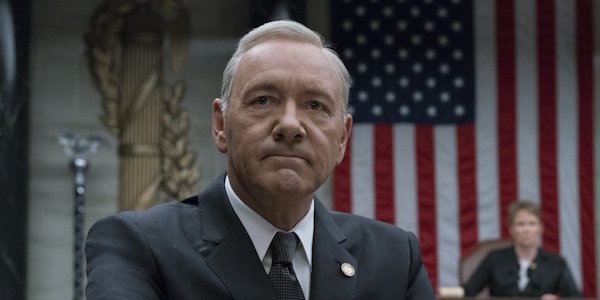 | |
| Actor Kevin Spacey as Frank Underwood |
This follows a series of allegations of sexual harassment and sexual assault leveled against the actor from various House of Cards male crew, former colleagues and actor Anthony Rapp, who made public last weekend complaints that Spacey made inappropriate advances on him when Rapp was 14 (and Spacey was 26.)
It also follows the maelstrom that has erupted across Hollywood recently in response to allegations against movie mogul Harvey Weinstein and other powerful straight men.
For a country that heard gross admissions of sexual assault and harassment from Donald Trump, but then proceeded to "elect" him anyway over a more qualified woman, these recent developments are a minor step in the right direction. We have to continue to fight to make sure all sexual predators, straight or queer, pay for their behaviour (that means that Trump must be tossed out on his ass in 2020 if not sooner). It's nice to see that the immense bravery it takes to come forward with allegations like these is being partially rewarded with some major professional consequences for those who clearly seem, due to the mere volume of complaints, to be far from innocent. That's heartening.
This article this week by writer Natasha Chart proved to be one of the best articles on the connection between sexism and homophobia I've ever read. I recommend it highly.
But back to Kevin Spacey and 'House of Cards.' Please allow me a bit of glee at Spacey's demise from the increasingly tiresome show. This was a show that since Season 3 or 4 (of six) has become incredibly annoying, ditching any pretense for realism in favour of the repeated formula that went something like this: "Let's introduce weak adversaries for Frank, let them annoy him for an episode or two, then let Frank flick them away like dust off his lapel only to become stronger and even more powerful than before. Repeat."
It wasn't good writing the last three seasons, it was bullshit. No politician has ever experienced the kind of uninterrupted climb to immense power as Frank Underwood. And to get there, Underwood killed at least two people. Furthermore, his wife Claire joined the murderous club last season just before the heavy-handed writers made her President of the U.S.
I've been watching 'House of Cards' since the first season but have been disappointed since Season 3. I stopped watching mid-way through Season 6 when it became clear the writers were taking delight in deceptively teasing us with the continued hope that Underwood and his wife would finally pay in any major way for their crimes. In life, that kind of evil should face consequences, but so rarely does. The last thing I need is to experience dramatized and exploited evil in my entertainment. I'm kind of sensitive that way.
That's why I've also refused to watch the celebration of misogyny and violence against women that is "Game of Thrones." Other sadists may love that shit, but not me. (In a culture that adores such entertainment, is it any wonder that sexual harassment and violence against women remain such problems?)
Who could have foretold that Frank Underwood's demise would be due to the complaints of one man? Anthony Rapp is my new hero.
Subscribe to:
Posts (Atom)